
The mahogany paneling. The terrazzo floor. The pink tile in the hall bath. The steel kitchen with the chrome pulls. These are not problems to solve. They are assets to restore. The buyers who pay the highest premiums for mid-century modern homes know exactly what these finishes are worth, and they can immediately tell when someone has replaced them with something generic. Here is what restoration involves, what it costs, and why it returns more than it takes.
Mahogany Paneling
Mahogany and Philippine mahogany, also called lauan (pronounced “loo-AHN”), is the dominant wall material in East Coast and Midwest MCM homes. It was used as a design material, not just a wall covering. Its warmth, grain, and durability were central to the interior character of these homes.
A large proportion of original mid-century modern paneling has been painted by subsequent owners, often in an attempt to update or brighten the interior. Painted mahogany paneling is the single most common mistake MCM sellers leave unaddressed. Knowledgeable MCM buyers either discount heavily for painted paneling or walk away entirely.
Chemical strippers such as Peel Away and Citristrip work on flat panel surfaces but struggle in grooves. Heat guns can lift paint without raising the wood grain. Professional stripping and refinishing runs $25 to $60 per 4x8 panel depending on the number of paint layers and condition underneath. For a home with paneled walls throughout, this is a meaningful investment. In a pedigreed MCM market, it typically returns considerably more than it costs.
For intact original paneling, clean with Murphy Oil Soap or Howard Feed-N-Wax. Refinish with tung oil, Danish oil, or Watco Danish Oil. Avoid varnish or polyurethane; they change the appearance and feel and signal a non-authentic restoration to informed buyers.
Terrazzo
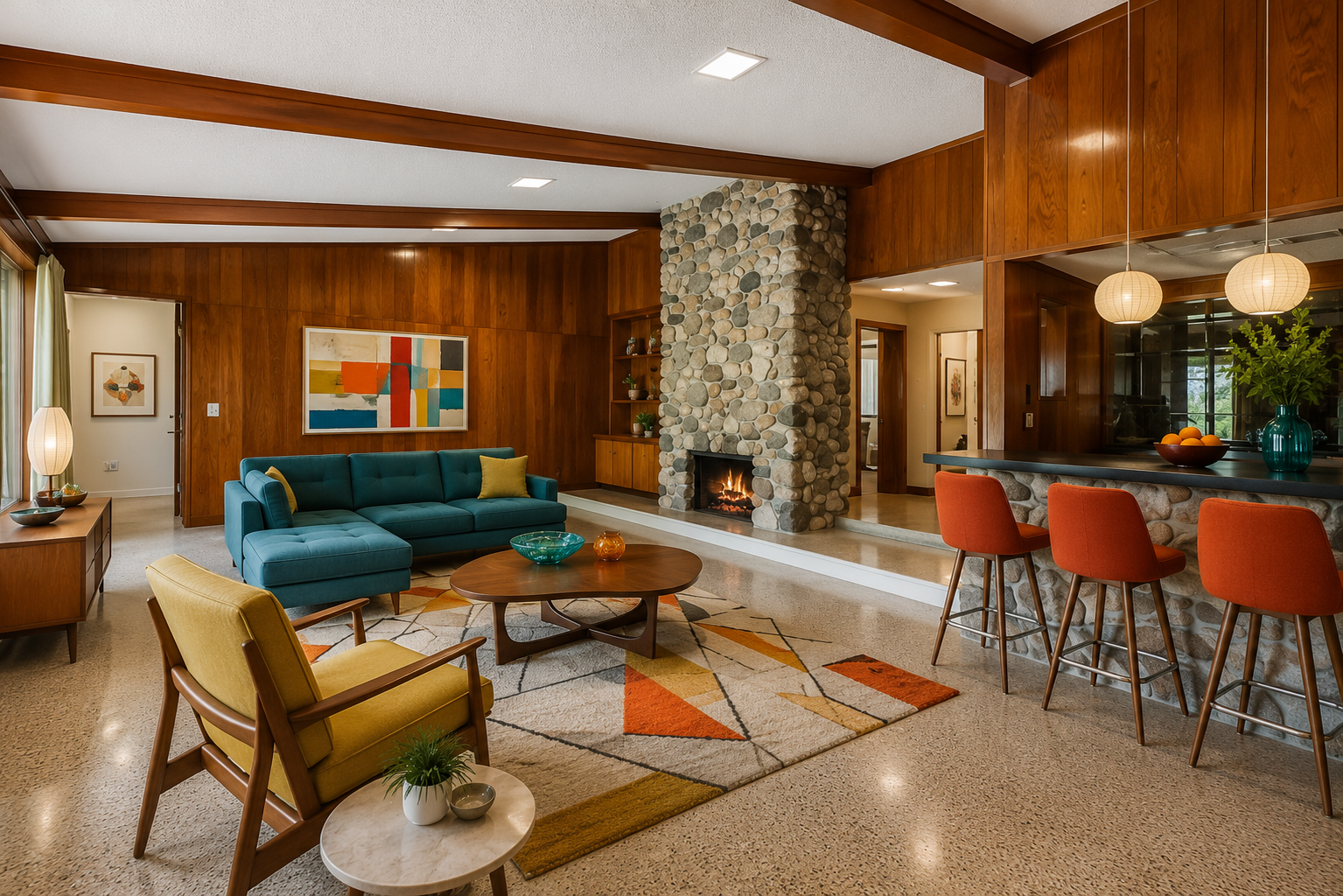
Terrazzo is a composite flooring material made of marble chips or other aggregate set in a cement or epoxy matrix and ground smooth. Its lifespan is effectively indefinite when maintained. It is naturally antimicrobial, extraordinarily durable, and impossible to reproduce at standard residential prices. A polished terrazzo floor in a well-maintained MCM home is a premium feature that adds immediate value.
Restoration involves cleaning with a neutral pH cleaner (never acidic products, which etch the cement matrix), filling cracks with matching epoxy and ground aggregate, honing and polishing with progressively finer diamond grinding pads, and sealing with a penetrating densifier that enhances color and reduces staining. Professional restoration runs $3 to $8 per square foot for grinding and polishing; complex crack repair by a skilled terrazzo craftsman costs $15 to $40 per square foot.
New terrazzo installation, if you are adding it to an area that lacks the original, runs $15 to $30 per square foot for cement terrazzo and $25 to $50 for epoxy terrazzo with no grout joint.
Period Ceramic Tile
Mid-century modern bathrooms and kitchens frequently feature 4x4 or 3x6 ceramic tile in period colors: pink, teal, avocado green, black, charcoal, and white with colored grout. Intact original tile in period colors is increasingly desirable among MCM buyers. It is authentically period, the colors are genuinely beautiful, and replacing it with modern equivalents is more difficult than most owners expect.
For grout: deep-clean first, then re-grout over existing grout if depth allows, or carefully remove and replace with a matching color. For matching discontinued tile: Subway Ceramics and Pratt and Larson produce period-appropriate colors. Original tile can sometimes be found at demolition salvage sources including Architectural Salvage, Olde Good Things, and Habitat for Humanity ReStore locations.
If you must replace tile, match the format and glaze type. Semi-gloss was the period standard. Matte modern tile will not blend with an original installation.
Steel Kitchen Cabinets
Well-known brands include St. Charles (the most prestigious), Geneva Steel, Youngstown, Steel-Craft, and Lyon Metal. Produced from approximately 1945 to 1975, they were marketed as hygienic, durable, and thoroughly modern. Their concealed hinges and clean-line hardware anticipated contemporary kitchen design by decades.
Restoration involves sanding and repainting with industrial enamel (original colors were typically white, gray, or two-tone), replacing drawer slides with modern equivalents, and refinishing or replacing the countertop surface. The MCM Steel Kitchen Facebook group is an active resource; Cabinetparts.com stocks compatible hardware; some regional specialists handle full restorations.
In a pedigreed MCM home, an original St. Charles kitchen in good condition is a significant premium feature. In a home where the kitchen is beyond restoration, period-appropriate replacement door fronts from Semihandmade or Reform on Ikea Sektion boxes are a sensible and authentically styled alternative.
The Resale Math
Restoration beats replacement in pedigreed mid-century modern homes. When restoration is not feasible, period-appropriate replacement, not generic, is the right approach. As a rough benchmark: $10,000 to $30,000 invested in restoring original finishes, including paneling, terrazzo, tile, and a steel kitchen, can yield $30,000 to $80,000 or more in value uplift in an authentic MCM market.
Whether you are restoring to sell or to stay, a specialist agent knows which finishes add value in your specific market. Find a verified MCM expert at mcmauthority.com/get-matched.
